New York City
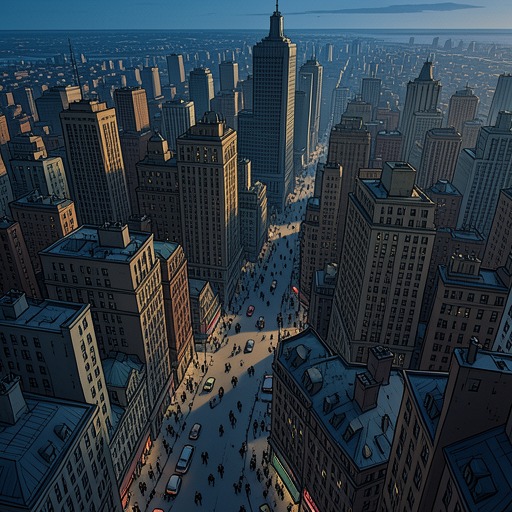
American PsychoNew York City is the novel’s decisive urban environment, a city where financial privilege, conspicuous consumption, homelessness, racial hostility, and spectacular violence occupy the same compressed geography. Its streets connect Wall Street, fashionable restaurants, corporate offices, retail interiors, Central Park, and neglected doorways, but they do not create community. Instead, New York City turns movement through space into a passage between social worlds that remain morally sealed off from one another.
Urban Structure and Social Contrasts
New York City first appears through the perspective of Timothy Price as a moving sequence of signs, advertisements, and commercial noise. Leaving Wall Street in a cab, he sees blood-red graffiti on a Chemical Bank building near Eleventh and First proclaiming "Abandon all hope ye who enter here" before a bus advertisement for Les Misérables blocks the words. The interruption is emblematic: urban warning, mass entertainment, and financial power continually cover one another. Price responds not to the warning but to the radio, offering the driver five dollars to turn up "Be My Baby," while another bus replaces the obscured message with a theatrical image marked by graffiti.
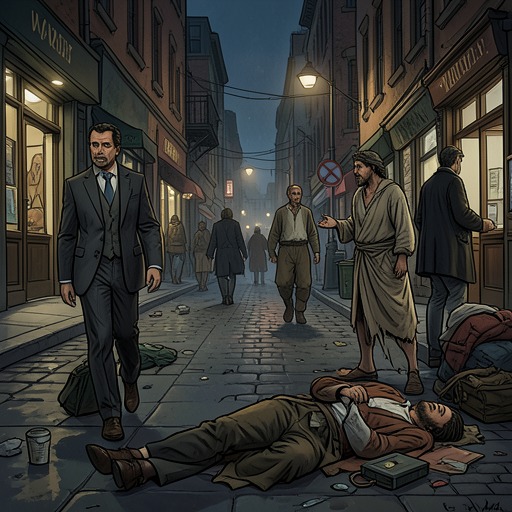
The city’s affluent districts are organized around access, taste, and service. At Pastels, a bill of $475 is divided among the diners and charged to an American Express Platinum Card, while an undrunk bottle of champagne remains on the table. Outside, a homeless man asks first for change and then, more hopefully, for food. The transition from expensive dining to street poverty takes only a doorway, yet the diners interpret the person outside as an inconvenience or joke rather than as part of the same urban system. In corporate spaces, the separation is maintained through clothing, brands, restaurants, and professional gossip: an elevator conversation moves from a Page Six item about Ivana Trump to an Italian-Thai restaurant on the Upper East Side, while the speaker’s Canali Milano suit, Bill Blass shirt, Missoni Uomo raincoat, and expensive haircut function as a social passport.
New York City also registers class through sensory excess. A gathering of silk ties and designer fragrances produces what Patrick Bateman describes as a "cold, sickening perfume," turning luxury into an atmosphere that is both seductive and nauseating. The city’s consumer network supplies the objects through which its residents identify and rank one another, but the accumulation of recognizable labels does not produce individuality. It produces a uniform surface beneath which people are repeatedly mistaken for one another.
Streets, Movement, and Social Exclusion
The city’s streets become most exposed when Bateman walks through the antique district below Fourteenth Street. He passes a newsstand, dry cleaner, church, diner, phone booth, and empty sidewalks while taxis move toward Union Square and steam rises from below the pavement. A torn Les Misérables playbill, garbage bags, a failing streetlamp, urine-stained concrete, and the distant ambulance siren give the district a decaying, almost infernal texture. The route is not outside the city’s prosperity; it is its underside, threaded through the same commercial and cultural signs that circulate downtown.
The homeless population is made visible in precisely this marginal space. A black man sleeps in the doorway of an abandoned antique store on Twelfth Street beside a Gristede’s shopping cart containing newspapers, bottles, and cans. A hand-painted sign identifies him as hungry and homeless, while his rail-thin dog, Gizmo, guards him. The scene establishes a stark contrast between private property and public exposure: the city contains stores, offices, and apartments, yet the man’s belongings must be arranged in a shopping cart and his shelter is an open doorway over a street grate.
Bateman’s encounter with Al demonstrates how New York City’s social boundaries become instruments of dehumanization. Al explains that he has lost his job and cannot find a shelter, but Bateman answers unemployment and hunger with the language of individual blame, telling him to get a job and accusing him of having a negative attitude. His temporary gesture of compassion collapses into contempt, and the city’s economic vocabulary becomes a pretext for violence. The homeless man is not merely ignored; he is treated as an object on which Bateman can enact the hierarchy separating designer clothing, money, and mobility from bodily exposure and dependence.
The city also makes movement itself unstable. After a telephone call with Jean, Bateman wanders through New York City in heat, sweat, hunger, cramps, and delirium. He throws a Sony Walkman into a trash can, considers buying a teapot, purchases butcher knives, an axe, hydrochloric acid, a Habitrail, and two white rats, shoplifts canned ham from a Gristede’s, vomits it near a Les Misérables poster, and later becomes trapped in a revolving door at Tower Records. The route passes retail stores, Broadway, Lafayette, the American Felt Building, and music shops, but the commercial city cannot restore coherence. Its objects become interchangeable outlets for compulsion rather than signs of stable identity.
Central Park and the Zoo
Central Park is both a refuge within the city and a concentrated display of its contradictions. The zoo is surrounded by Fifth Avenue apartment buildings, Trump Plaza, the AT&T building, carriage smells, drug dealers, and skyscraper tips. The natural world is therefore framed by finance, luxury real estate, street commerce, and managed entertainment. The animals appear stained, drugged, or morose, while the visitors gather to watch them; the zoo’s artificial nature mirrors a city in which life is constantly staged, contained, and consumed.
At the seals’ tank, a warning states that coins can lodge in an animal’s stomach and cause ulcers, infections, and death. Bateman throws change into the pool anyway, claiming that it is the audience’s enjoyment rather than the seals themselves that he hates. The gesture converts public entertainment into a miniature model of urban violence: spectators gather, danger is announced, and the warning becomes part of the spectacle rather than a barrier against it. His fascination with a snowy owl, whose eyes seem like his own, further turns the zoo into a distorted mirror in which recognition does not produce empathy.
The murder of a child in the penguin habitat follows this atmosphere of managed observation. A child barely five years old leaves his mother’s side to throw away a candy-bar wrapper and encounters Bateman behind a trash can. Bateman offers a cookie, then abruptly stabs the child in the neck. He returns to the crowd, points out a penguin preparing to dive, and watches the mother initially interpret the child’s hidden feet as play. The city’s public space thus permits violence to occur beneath the ritual of family entertainment, while the surrounding audience remains absorbed by the animals and the performance of leisure.
The zoo scene also exposes the relationship between visibility and recognition in New York City. The mother eventually discovers the child’s bloodied body and begins screaming, but Bateman has already merged back into the crowd. The public setting does not guarantee witnesses, accountability, or solidarity. It offers anonymity to the aggressor and delayed recognition to the victim, making the city’s density function less as collective protection than as camouflage.
Corporate and Commercial Circulation
New York City’s institutions are connected by a continuous circuit of finance, consumption, media, and professional display. Offices, restaurants, clubs, boutiques, banks, and entertainment venues form a single social field in which people carry status through cards, clothing, reservations, business affiliations, and cultural references. Even ordinary errands are described through brands and commercial destinations, so that the city’s geography becomes a catalogue of purchasable distinctions.
The same environment is haunted by contradictory reports of breakdown. At the office, Madonna lyrics repeatedly intrude into Bateman’s thoughts while the phrase "isolated farmhouse" returns with nameless dread. The newspaper reports bodies recovered from the East River and a maniac poisoning one-liter bottles of Evian water, with seventeen people dead. These reports place urban luxury beside random death and public anxiety, yet the office continues to operate through calendars, faxes, interviews, and management books. New York City absorbs catastrophe into its routine without producing shared understanding.
This flattening of difference is reinforced by professional misrecognition. Bateman encounters people who greet him by another name, and he himself is uncertain whether a person is Charles Murphy from Kidder Peabody or Bruce Barker from Morgan Stanley. The city’s corporate population is visually and socially interchangeable, while the institutions themselves are identified through recognizable firms and products. New York City therefore offers an immense density of contacts without personal knowledge: names, faces, jobs, and affiliations circulate, but identity remains unstable.
Decay, Violence, and Narrative Significance
By the later passages, New York City is rendered as a landscape undergoing literal and psychic collapse. Returning from Central Park near the place where he murdered the McCaffrey boy, Bateman imagines bodies covering Fifth Avenue, a skyline that has recently changed, low-flying airplanes, pigeons rising against the sky, and the smell of burning chestnuts mingling with carbon monoxide. The city’s famous surfaces remain—he still admires the gleaming Trump Tower—but decay has become impossible to separate from grandeur.
On Fifth Avenue, a homeless veteran whom Bateman previously blinded sits beneath a sign claiming he was blinded in Vietnam and remains hungry and homeless. His dog recognizes Bateman and reacts with suspicion and agitation, turning the encounter into a return of violence that the city has not resolved. The victim’s sign is itself a bitter act of public narration: it names injury, service, hunger, and homelessness, but those facts do not guarantee assistance. The city displays suffering in legible form while continuing to pass around it.
New York City’s significance lies in this simultaneous visibility and nonrecognition. Its advertisements, financial buildings, designer goods, theatrical posters, luxury towers, abandoned stores, zoo enclosures, and homeless doorways all share the same narrative space. The city does not simply provide a backdrop for Bateman’s violence; it supplies the social arrangements that make his violence conceivable, deniable, and difficult to distinguish from the ordinary aggression of status competition. Through Bateman’s unreliable perception, New York City becomes both a real metropolitan environment and a nightmare of late-capitalist interchangeability, where public life is crowded with people yet emptied of mutual obligation.